
As global regulatory frameworks tighten and enterprise net-zero targets mature, the voluntary carbon market is undergoing a fundamental transformation. It is maturing into a standardized, institutionally governed environmental commodity market, where buyers evaluate credits against published integrity benchmarks rather than project claims alone.
Under the guidance of the Integrity Council for the Voluntary Carbon Market (ICVCM) and the Voluntary Carbon Markets Integrity Initiative (VCMI), corporate buyers and project developers are aligning around standardized integrity benchmarks, rigorous MRV (monitoring, reporting, and verification), and transparent registry accounting.
This guide explores the mechanics of carbon credits: how units are quantified, the core differences between avoidance and removal, how buyers can ensure audit-defensible claims, and how project developers can structure bankable environmental assets.
What is a Carbon Credit?
A carbon credit is a standardized, certified instrument representing the reduction, avoidance, or removal of one metric tonne of carbon dioxide equivalent (1 tCO2e) from the atmosphere.
Credits are issued under independent crediting standards such as Verra's Verified Carbon Standard (VCS), Gold Standard, Global Carbon Council (GCC), and Puro.earth for durable carbon removals. Each credit represents proof that a real-world project either prevented emissions from happening or pulled carbon out of the air, verified against a strict baseline.
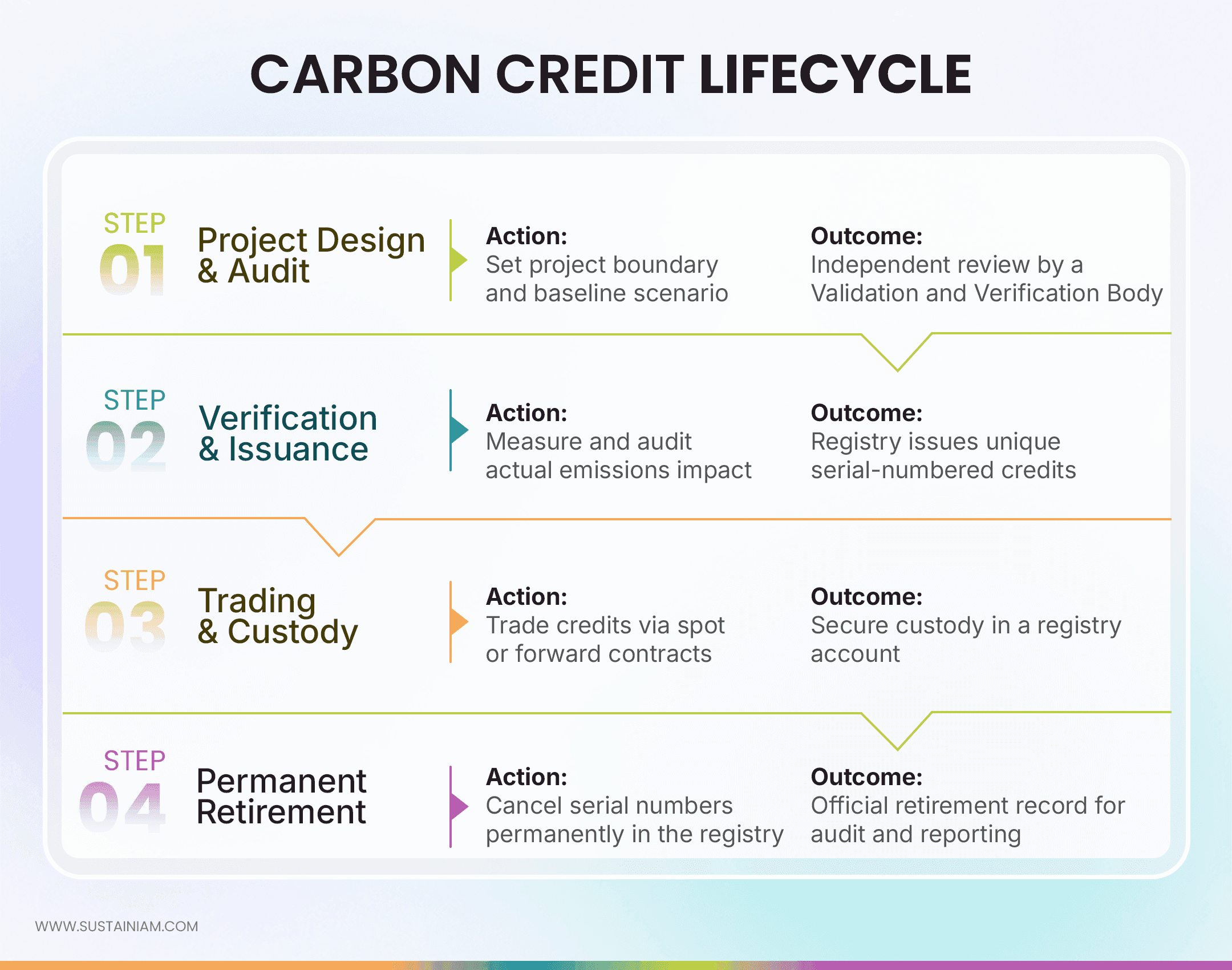
Once issued, each carbon credit carries a unique serial number in a public registry. When an organization uses a credit, whether to meet a voluntary net-zero commitment or satisfy a mandatory compliance obligation such as CORSIA or a national carbon tax, that credit must be permanently retired in the registry. Retirement ensures the environmental benefit cannot be resold, transferred, or claimed by another party.
The 4 Main Types of Carbon Credits
Today's carbon market divides projects into two main categories, which then split into four project types. Avoidance prevents emissions that would otherwise have occurred, while Carbon Dioxide Removal (CDR) actively pulls CO2e out of the atmosphere and stores it durably.

What Buyers Need to Know
For the teams responsible for corporate climate strategy, finance, and procurement, carbon credits serve as a strategic tool for climate compensation and long-term risk mitigation.
1. How Carbon Credits Fit into Corporate Carbon Accounting
Under the GHG Protocol Corporate Standard, organizations cannot subtract carbon credits directly from reported Scope 1, Scope 2, or Scope 3 emissions.
Purchasing and retiring carbon credits does not reduce a company's gross operational footprint. Instead, credits are reported separately and serve three distinct purposes:
Neutralizing Residual Emissions: Balancing the unavoidable emissions that remain after a company has delivered its long-term science-based reduction targets. Residual levels vary by scope and by sector under the SBTi Corporate Net-Zero Standard rather than following a single cross-scope percentage. Only carbon removals qualify for neutralization claims.
Ongoing Emissions Responsibility (OER): Under Version 2.0 of the SBTi standard, companies can voluntarily take recognized responsibility for emissions released during their transition by funding verified mitigation beyond their value chain. From 2035, this becomes mandatory for Category A companies (large firms, plus medium-sized firms in high-income countries), starting at a minimum of 1% of ongoing Scope 1, 2, and 3 emissions and rising to full neutralization of residual emissions at the net-zero target year. Version 2.0 opens for target validation in early 2027 and becomes mandatory for all submissions from February 2028.
Meeting Compliance Obligations: Satisfying regulatory requirements such as CORSIA for international aviation or national carbon tax schemes in jurisdictions like Singapore, Colombia, and South Africa that permit credit surrenders.
This separation keeps corporate reporting transparent and prevents organizations from using credits as a substitute for cutting their own operational emissions.
2. The ICVCM Core Carbon Principles (CCPs)
To reduce greenwashing risk, the market uses the Core Carbon Principles (CCPs) set by the Integrity Council for the Voluntary Carbon Market (ICVCM) as an independent quality benchmark. For a credit to carry the CCP label, it must clear two separate approvals:
CCP-Eligible Program: The issuing registry must meet standards for governance, registry tracking, transparency, and third-party verification.
CCP-Approved Methodology: The specific project methodology must demonstrate verifiable additionality, conservative baselines, durable storage, and social and environmental safeguards.
Thirteen programs are now CCP-Eligible, but the methodology bar is higher: more than 40 methodologies have been approved and around 25 rejected, including most legacy renewable energy and cookstove methodologies that account for a large share of credits ever issued. Roughly 115 million credits carry the CCP label (ICVCM, citing MSCI, July 2026). Program eligibility alone isn't enough, so confirm the exact methodology and version behind any credit you buy.
3. Understanding Carbon Credit Pricing
Carbon credit prices are not standardized. Two credits representing the same tonne of CO2e can differ in price by orders of magnitude, driven by storage durability, project geography, quality ratings, and compliance eligibility.
Avoidance credits sit at the low end of the market, with nature-based forest conservation clearing the lowest of all, though regional gaps can be significant where local policy or supply conditions restrict availability. Nature-based removals such as afforestation and blue carbon trade at a premium to avoidance credits, reflecting the added cost of actively growing new carbon stocks.
Durable engineered removals sit at the top of the market, commanding steep premiums for their multi-century storage. Biochar is currently the most established and accessible option, while direct air capture remains the most expensive, often several times the price of biochar per tonne. Projects with strong co-benefits and high integrity ratings clear above their category average. Credits eligible for compliance schemes such as CORSIA carry a further premium.
(Directional guidance only. For current pricing, refer to MSCI Carbon Markets, CDR.fyi, and the Nasdaq/Puro CORC index. Prices move continuously and should be verified before procurement.)
What Project Developers Need to Know
For project developers and environmental asset owners, carbon credits represent an essential project finance mechanism to monetize climate mitigation.
1. Proving Financial and Regulatory Additionality
A project is only eligible for credit issuance if it satisfies the principle of additionality, meaning the climate benefit would not have happened without revenue from carbon credits. Registries assess this through several complementary tests:
Financial Need: The project depends on carbon credit sales to be financially viable, rather than being profitable on its own.
Beyond Legal Requirements: The project goes above and beyond existing laws, rather than simply complying with government regulations or industry mandates.
Not Already Common Practice: The activity is not already standard behaviour in that market or sector, which would suggest it would have happened regardless of carbon finance.
2. Protecting Against Carbon Reversal (Buffer Pools)
For nature-based projects like forestry and soil management, there is always a risk that stored carbon returns to the atmosphere through wildfires, disease, or land-use change. Registries manage this risk through a shared insurance mechanism called a buffer pool.
Here is how it works under Verra's AFOLU Non-Permanence Risk Tool:
Risk-Based Contributions: Every project undergoes a risk assessment covering natural hazards, project management, and political factors. The resulting risk score determines how many credits the developer must deposit into a collective reserve, with a minimum contribution of 12%.
Non-Tradable Reserves: Buffer credits are held by the registry and cannot be sold or transferred by the developer.
Automatic Compensation: If a reversal occurs, the registry cancels credits from the pooled buffer to cover the loss. Credits already sold to buyers remain permanently valid.
Minimum Project Longevity: Projects must commit to a project longevity period of at least 40 years, ensuring the climate benefit is maintained well beyond the initial credit issuance.
Hard Risk Ceiling: Projects scoring above the maximum acceptable risk threshold fail the assessment entirely and cannot issue credits until risks are mitigated.
3. Commercialization: Spot Sales vs. Multi-Year Forward Offtake
Developers generally structure credit sales across two primary mechanisms:
Long-Term Forward Offtake Agreements: Multi-year purchase contracts with financially strong corporate buyers help cover heavy upfront build costs and give lenders the revenue certainty they need to fund the project.
Spot Market Sales: Selling uncommitted credits directly at prevailing market prices, which lets developers capture immediate demand during corporate reporting cycles.
How Sustainiam Supports the Carbon Market Ecosystem
Navigating carbon commodity markets requires digital operating infrastructure that integrates carbon accounting with transparent market access:
For Buyers, Sellers & Traders: Sustainiam EmX is a unified platform for buying, selling, and trading carbon credits and EACs. You can access credits across registries, leverage 15-day inventory reservations, and execute trades with assured settlement (T+1).
For Carbon Accounting: ECal (Emission Calculator) measures Scope 1, 2, and 3 emissions across operations and supply chains, giving companies the audit-ready footprint data needed to determine their net-zero targets and credit procurement needs.
Conclusion
Carbon credits provide a practical mechanism to finance emissions reductions and removals around the world. As the market standardizes under frameworks like the ICVCM Core Carbon Principles and Article 6 of the Paris Agreement, the focus has shifted decisively toward verified project quality, proven additionality, and durable storage.
Whether developing projects to generate credits or purchasing them to address residual emissions and compliance obligations, the fundamentals remain the same: understand what the credit represents, verify it in the registry, and retire it transparently.



